Agentic operating system
Compound Agent OS
An AI operating system for serious knowledge work — one person running a full team of specialized agents through a real-time command center.
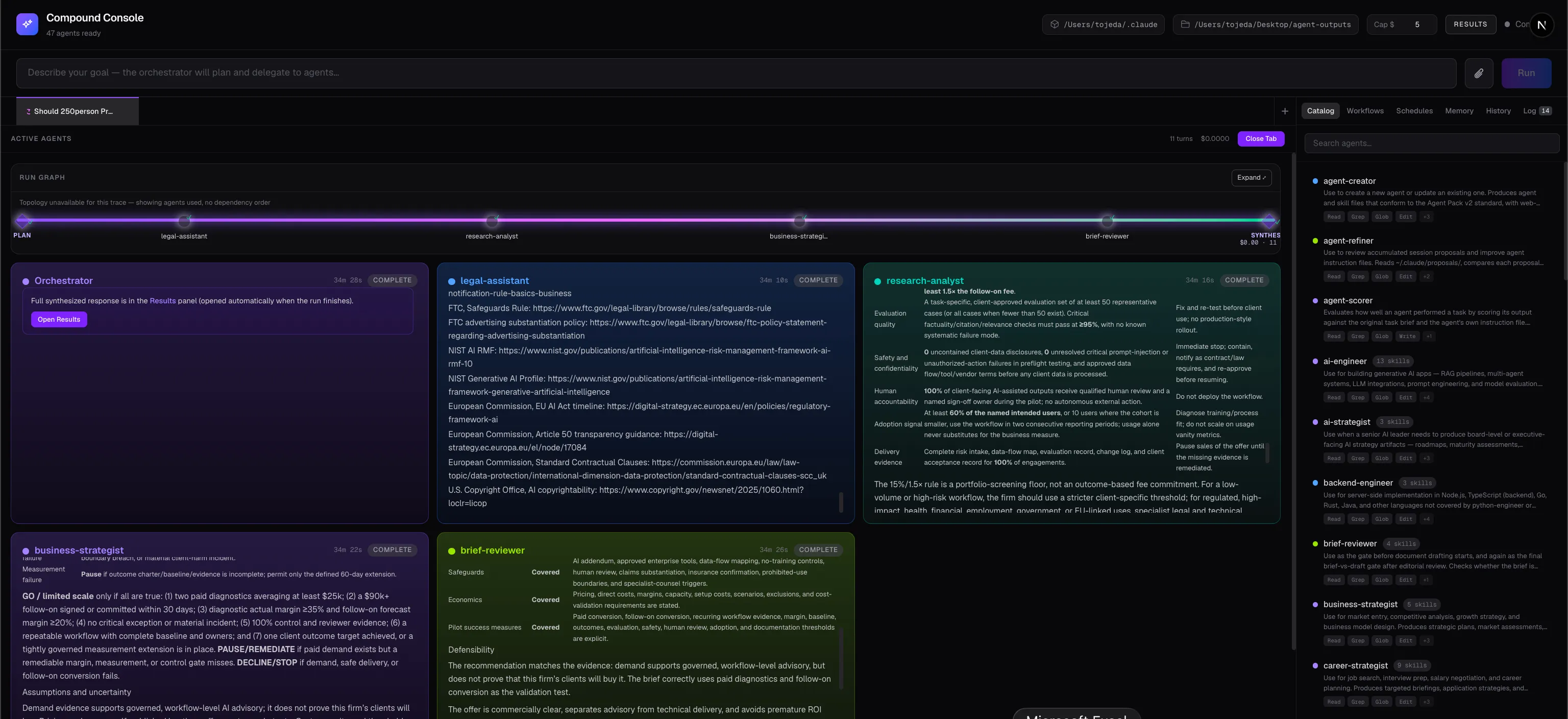
Compound Agent OS is an AI operating system for serious knowledge work: a growing roster of specialized agents, shared skills, and persistent memory that lets one person operate with a team’s worth of leverage. The point is not just parallel output. It is compound improvement. Each refinement to an agent, skill, workflow, or memory layer makes the whole system more capable over time.
The Problem
A general-purpose chat window doesn’t accumulate anything. Every session starts from zero: you re-explain your standards, reload context the assistant should already know, and correct the same mistakes it made last week. That’s not delegation — it’s operating a tool with no institutional memory.
The fix isn’t a smarter model. It’s a system: agents scoped narrowly enough to be reliable, skills that get sharper the more they’re used, and a memory layer that carries lessons forward instead of resetting every session. Narrow, job-shaped agents are also easier to route work to, cheaper to run, and more consistent than one generalist “senior AI” asked to do everything.
Demo
How It Works
Agents are defined in markdown: role, personality, expertise, and constraints. They share a growing library of reusable skills and a memory layer that preserves how I want work done across projects and over time. When I give the system a goal, the runtime coordinates the right specialists, manages execution, and turns the result into usable output.
What matters is not just that the agents can work in parallel. It is that the system compounds. A better agent definition improves future work. A sharper skill lifts every agent that uses it. A stronger workflow reduces coordination overhead. A richer memory layer makes the next session more precise. What looks like a collection of agents from the outside is really a system designed to get better at getting better.
Three layers support that:
- The Roster — the full collection of agents and their composable skills
- The Blueprint — the personal memory and reference layer that makes the system specific to me
- The Console — the runtime that coordinates execution, streaming, and delivery
The Roster
- Build — AI Engineer, Frontend Designer/Developer, Data Engineer, DevOps Engineer
- Review & Document — Spec Generator, Code Reviewer, Documentation Engineer, User Tester
- Research & Analyze — Research Analyst, Data Scientist, Competitive Intelligence
- Strategize — Business Strategist, Project Manager, Marketing Strategist
- Write & Reach — Personal Writer, Outreach Strategist, Career Strategist
- Advise — Legal Assistant, Financial Strategist, Stock Analyst
The agents share a growing library of reusable skills covering everything from RAG system design to contract review to dbt development. The result is not a generic assistant pretending to do everything. It is a designed operating system for knowledge work, built to extend judgment and compound capability over time.
Key Design Decisions
Narrow agents over one generalist. Every agent is scoped to a single job — a code reviewer isn’t a software architect, a data engineer isn’t a data scientist. Less impressive-sounding than one AI that does everything, but narrow agents are easier to route work to, cheaper to run, and produce more consistent output.
The system isn’t allowed to rewrite its own rules unsupervised. For a while, the consolidation layer could apply new instructions to an agent automatically whenever it inferred a pattern. That made growth the default path: instruction files grew by 466,348 characters while instruction-adherence scores — the exact thing more rules were supposed to fix — stayed flat. I removed automatic rule application in August 2026. Now every new rule has to survive three questions before it’s applied: what specific failure does it prevent, why doesn’t an existing rule already cover it, and what does it cost in size. Most proposed rules don’t clear that bar, which is the point.
Results
- 47 specialized agents and 114 reusable skills, grown from an original roster of 25 over about ten months of continuous use
- 1,140+ commits refining agents, skills, and the memory/evaluation system since October 2025
- 353 logged runs captured by the system’s own flight recorder, and 759 sessions scored across 31 agents on task completion, instruction adherence, output quality, and handoff quality — the raw material a weekly consolidation pass uses to propose improvements
Tech Stack
Markdown and YAML for agent and skill definitions (no vendor lock-in), the Claude Agent SDK for the Compound Console orchestration runtime, Claude Code, Cursor, and Codex as alternate harnesses, a Python CLI for the flight recorder, JSONL for score records, and git for version-controlling every agent, skill, and instruction change.